
What Are Trade Plates And How Do They Work?


Trade plates are temporary registration plates issued by the DVLA that allow motor traders to drive untaxed and unregistered vehicles on public roads for business purposes.
They save motor trade businesses both time and money. Instead of taxing and registering every vehicle you hold as stock, you attach a set of trade plates and drive legally.
You’ll need motor trade insurance before you can apply for trade plates, because the DVLA requires proof of a valid motor trade insurance certificate with your application.
Trade plates cover road tax and registration, not insurance. You need motor trade insurance before you can even apply, and the DVLA requires a valid certificate with your application. Mount them externally (not on the dashboard) and log every journey, because the DVLA can check your records at any time.
Get motor trade insurance first when you compare motor trade insurance quotes.
What are trade plates used for?
Trade plates let you move vehicles that aren’t taxed or registered without breaking the law. They’re used for test drives, deliveries between sites, trips to auction, and moving stock to and from your premises.
How are trade plates different from normal registration plates?
A normal registration plate is tied to one specific vehicle. A trade plate is tied to the business that holds the trade licence, so you can move it between vehicles.
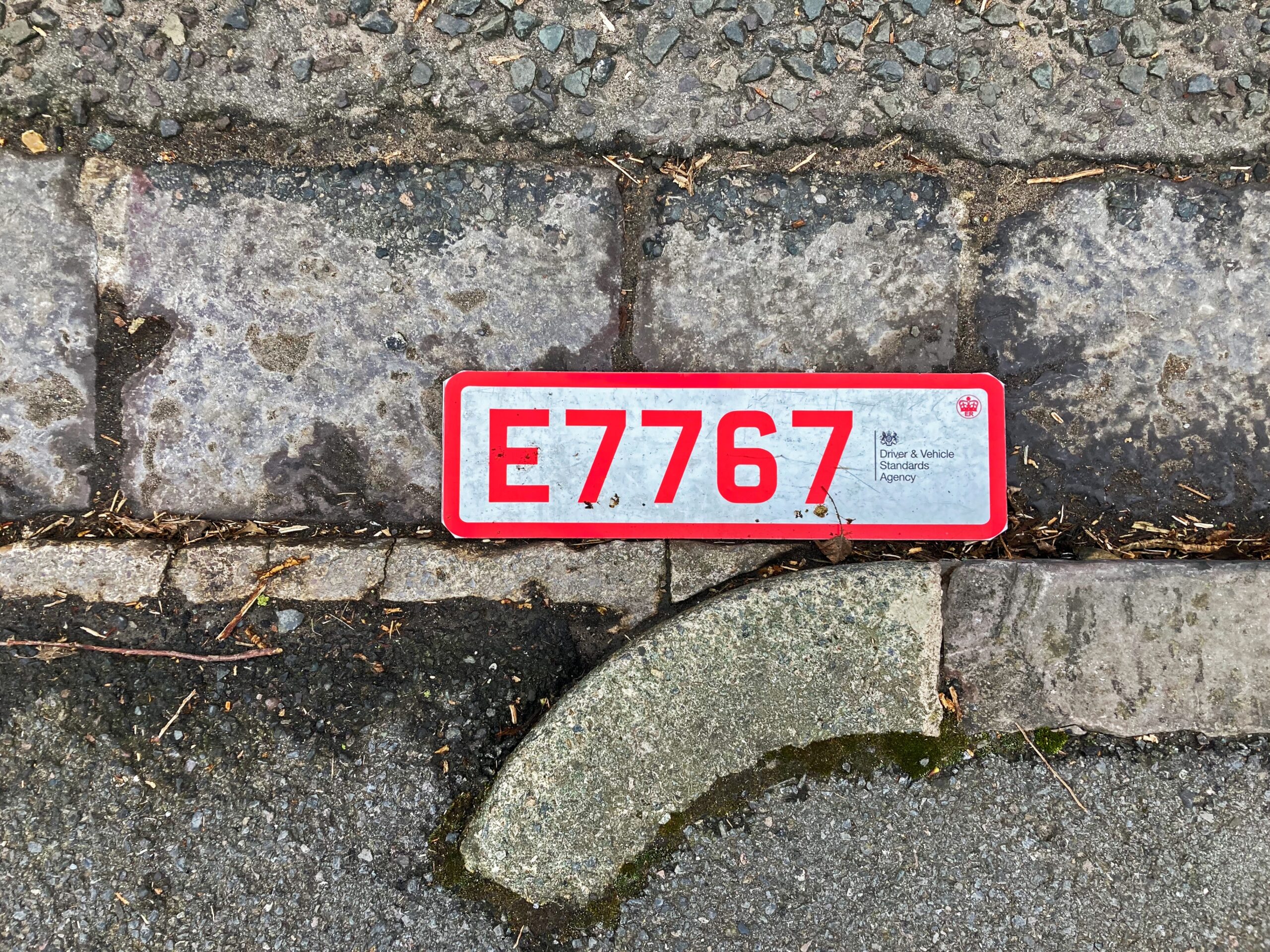
Trade plates have red characters on a white background, making them easy to distinguish. They’re issued as a pair: one for the front and one for the rear of the vehicle.
Who needs trade plates?
Any motor trade business that drives untaxed or unregistered vehicles on public roads needs trade plates. This includes full-time dealers, part-time traders, mechanics, vehicle transporters, and manufacturers.
Common examples include car dealers, garages, body shops, mobile mechanics, valet services, and businesses that fit accessories or carry out MOTs.
Do part-time traders need trade plates?
If you regularly buy and sell vehicles as a part-time motor trader, you’ll need trade plates whenever you drive untaxed stock on a public road. Even a short trip to collect a vehicle from a seller counts.
If a vehicle is already taxed and registered, you can drive it on your existing motor trade insurance without trade plates. The plates are only needed for untaxed or unregistered vehicles.
How do you apply for trade plates?
You apply through the DVLA using the trade licence plates service on GOV.UK. You’ll need to provide proof of your motor trade business and a valid motor trade insurance certificate.
What forms do you need?
The DVLA uses different forms depending on your situation. Form VTL301 is for first-time applications, VTL318 is for renewals, VTL308 is for refunds, and VTL310 is for replacements.
All trade licences expire on either 30 June or 31 December. First-time applicants may receive a licence lasting between 6 and 12 months, depending on when they apply, to align with these fixed expiry dates.
How much do trade plates cost?
A 12-month trade plate licence costs £177 for motor vehicles, while a 6-month licence costs £97.35.
Prices are lower for motorcycles, bicycles, and tricycles. The exact cost depends on which month you apply, because all licences expire on fixed dates.
| Application Month | Expiry | Duration | Vehicle Price | Motorcycle/Bicycle |
| January | June | 6 months | £97.35 | £54.13 |
| January | December | 12 months | £177.00 | £98.43 |
| February | December | 11 months | £177.00 | £98.43 |
| March | December | 10 months | £162.25 | £90.23 |
| April | December | 9 months | £147.50 | £82.03 |
| May | December | 8 months | £132.75 | £73.83 |
| June | December | 7 months | £118.00 | £65.63 |
| July | December | 6 months | £97.35 | £54.13 |
| August | June | 11 months | £177.00 | £98.43 |
| September | June | 10 months | £162.25 | £90.23 |
| October | June | 9 months | £147.50 | £82.03 |
| November | June | 8 months | £132.75 | £73.83 |
| December | June | 7 months | £118.00 | £65.63 |
Trade plates are one of the smaller costs of running a motor trade business. Your biggest ongoing expense will be your insurance.
See our guide to how much motor trade insurance costs for a full breakdown of premiums and what affects the price.
What are the rules for displaying trade plates?
The Road Vehicles (Registration and Licensing) Regulations 2002 require trade plates to be displayed on the outside of the vehicle, in the same position as a standard registration plate.
Can you display trade plates inside the car?
No, trade plates must be mounted externally on the front and rear of the vehicle. Placing them on the dashboard or parcel shelf is illegal.
They must be readable from a distance of at least 20 metres. If they’re obscured or poorly mounted, ANPR cameras won’t read them and you risk a fine.
Police use ANPR cameras across the UK road network to check whether vehicles are taxed and insured. Correctly displayed trade plates ensure your vehicles pass these automated checks without issue.
What can you not use trade plates for?
Trade plates are strictly for business use. You cannot use them for personal driving, commuting, or any journey that isn’t directly related to your motor trade business.
Permitted uses include test drives, delivering vehicles to customers, trips to auctions, and moving stock between sites. Vehicle transportation between premises or to a port for export is also covered.
What happens if you misuse trade plates?
Misusing trade plates is a criminal offence. Penalties include fines, penalty points, and in serious cases, prosecution.
What counts as misuse?
Using trade plates for personal journeys, lending them to someone outside your business, or displaying them on a vehicle you don’t hold for trade purposes are all offences. The DVLA can also revoke your trade licence if you break the rules.
You must also keep records of every journey made using trade plates, including the driver’s name, date, and purpose. This is a condition of holding a trade licence and the DVLA can ask to see your records at any time.
Make sure you hold the right road risk insurance to cover every driver using your trade plates. Without it, both the driver and the business are breaking the law.
Related: How to Become a Car Trader in the UK
Frequently Asked Questions (FAQs)
A 12-month licence costs £177 for motor vehicles and £98.43 for motorcycles, bicycles, and tricycles. A 6-month licence costs £97.35 for motor vehicles.
You can use trade plates on any vehicle you hold temporarily for the purposes of your motor trade business. This includes cars, vans, motorcycles, and trailers.
No, trade plates only cover you for road tax and registration. You need a separate motor trade insurance policy to drive vehicles legally.
You can carry passengers if the journey is directly related to your motor trade business. For example, a customer on a test drive or a colleague travelling to collect a vehicle.
Yes, all trade plate licences expire on either 30 June or 31 December. You need to renew before the expiry date to keep using them.
Yes, trade plates allow you to drive a vehicle that has been declared SORN on public roads for trade purposes. Without trade plates, driving a SORN vehicle on a public road is illegal.
Yes, the DVLA requires a valid motor trade insurance certificate as part of your trade plate application. You cannot apply without one.