
How Can Landlords Prevent Damp and Mould in Rental Properties?


Prevention comes down to three things: extract fans that hit the rates in the building regulations, background ventilation nobody can switch off, and surfaces warm enough that moisture never condenses on them. Get those right and most rental mould never appears.
Almost every mould complaint a letting agent takes turns out to be condensation on a cold surface rather than water getting in. That matters, because the cure for condensation has nothing in common with the cure for a leaking gutter.
Diagnose the damp first, then spend the money on the cause rather than the stain. Painting over black speckle buys you about six weeks.
Most rental mould is condensation on a cold surface rather than water getting in, so diagnose the damp before you spend anything on it. Extract fans that meet the building regulation rates, background ventilation nobody can switch off and surfaces warm enough to stop moisture settling will deal with the bulk of it. Reply in writing when a tenant reports mould and keep the inspection records, because those are what protect you if the council gets involved.
Compare landlord insurance quotes while you plan the ventilation work.
- Which type of damp are you dealing with?
- What ventilation rates stop condensation?
- How do you stop cold surfaces growing mould?
- Why is blaming tenant lifestyle a losing argument?
- What should you do when a tenant reports mould?
- What records protect you if the council gets involved?
- Frequently asked questions (FAQs)
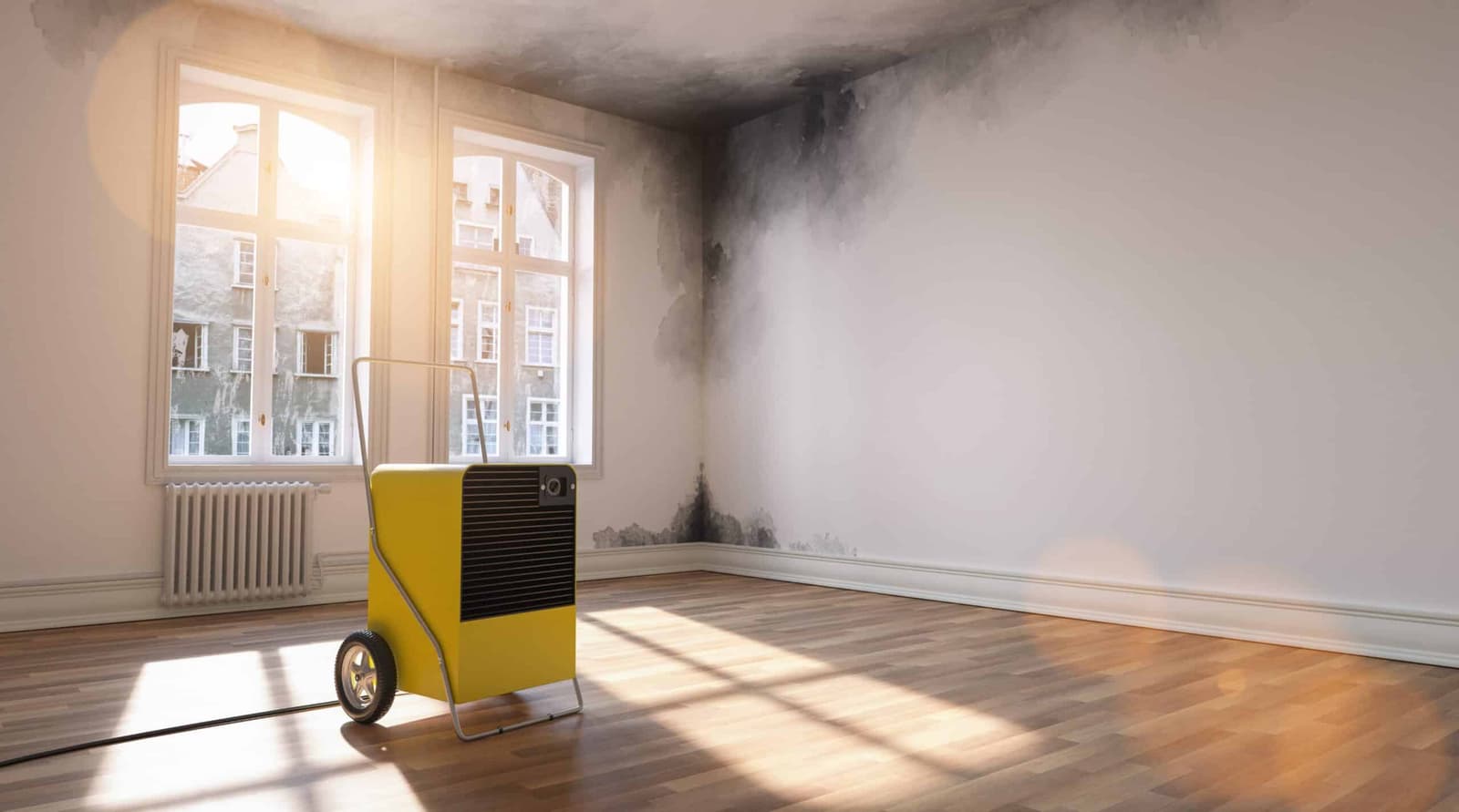
Which type of damp are you dealing with?
Condensation, penetrating damp and rising damp look almost identical in a tenant’s photograph and need completely different work. Diagnose it wrong and you pay twice.
Reading the Pattern on the Wall
Condensation shows as fine black speckling in corners, on window reveals and behind furniture pushed against external walls. It appears from October, fades by May and is worst in bedrooms and bathrooms.
Penetrating damp is a defined patch that darkens within a day of heavy rain and dries slowly afterwards. Follow the water upwards: a roofer will usually find a blocked gutter, a slipped tile or failed flashing directly above it.
Rising damp is rarer than the industry suggests. It leaves a tide mark up to about a metre high with a salt bloom, sits on ground floor walls only, and often turns out to be a bridged damp proof course where a path, flower bed or render has been built up over it.
A patch that stays wet in July is neither condensation nor rain. Get a plumber to trace it before anyone reaches for a damp treatment.
The diagnosis table
| Symptom | Likely cause | What fixes it | Typical cost |
|---|---|---|---|
| Black speckling in corners, on reveals and behind furniture | Condensation | Extract fans, trickle vents, insulation, heating | £240 to £900 |
| Tide mark up to a metre with a white salt bloom | Rising damp or a bridged DPC | DPC repair or injection plus replastering | £1,000 to £3,000 |
| A defined patch that darkens after rain | Penetrating damp | Clear gutters, repoint, repair roof or flashing | £150 to £1,200 |
| A patch that never dries, wet in summer too | Plumbing or waste leak | Trace and repair, then dry the fabric | £150 to £600 |
| Mould on a top floor ceiling near the eaves | Cold bridge or failed roof covering | Top up loft insulation, recover the roof | £650 to £6,000 |
| Mould around a bath with a silent, weak fan | Undersized or blocked extract fan | Humidistat fan rated at 15 litres a second | £240 to £350 |
| Misting between the panes of a window | Failed sealed unit | Replace the glazing unit, keep the frame | £120 to £300 per unit |
Two cheap readings settle most arguments. A £15 hygrometer left in the room for a week and a moisture meter reading on the wall will separate a condensation problem from a wet one.
When a survey is worth paying for
An independent damp survey costs around £300, with a range of £100 to £600. Pay for it when the pattern does not match any single cause, or when a tenant has already involved the council.
Be wary of the free survey offered by a firm that sells injected damp proof courses. Its report will rarely conclude that you need a £280 extract fan.
What ventilation rates stop condensation?
Approved Document F sets the numbers: 15 litres a second in a bathroom, 30 in a kitchen with a hood venting outside and 60 where there is no hood. A fan quieter and weaker than that is decoration.
Extract fans and the rates they have to hit
For intermittent fans the minimum extract rates are 15 litres a second in a bathroom, 30 in a utility room and 6 in a separate WC. Kitchens need 30 litres a second where the cooker hood vents outside, and 60 litres a second where it does not.
Continuous mechanical extract works to lower boost figures: 13 litres a second in a kitchen and 8 in a bathroom or utility room. It runs quietly all day, which is why tenants leave it alone.
Specify a humidistat model with a 15 minute overrun so it deals with the shower after the tenant has left the room. Budget £240 to £350 fitted, and use rigid duct on the shortest run you can manage.
Flexible duct that sags or doubles back can halve the measured throughput. In an HMO with three or four people sharing one bathroom, that shortfall shows up as mould within a single winter.
Trickle Vents and the 8,000 mm² Rule
Replace a window and you have to fit background ventilators with an equivalent area of at least 8,000 square millimetres in habitable rooms and kitchens, and 4,000 in bathrooms. Fitters skip them when the customer complains about draughts.
The 2026 edition of Approved Document F applies to work started from 24 March 2027 and keeps the same rates. Nothing you specify now becomes obsolete next year.
Walk the property looking for taped-over vents, painted-shut air bricks and sealed chimney breasts. Unblocking those costs nothing and is often the single most effective thing you will do all year.
When a piv unit earns its keep
A positive input ventilation unit sits in the loft and pushes gently filtered air into the landing, diluting moisture across every room instead of extracting it from one. It suits properties where mould appears in bedrooms rather than only in wet rooms.
Installed cost runs from about £750 to £1,750, and a standard unit costs a few pence a day to run. Flat-mounted versions exist for apartments with no loft space.
A PIV unit will not rescue a property with a live leak or a bridged DPC. Fix the water first, then treat the humidity.
| Measure | Rate or specification | Installed cost | Best for |
|---|---|---|---|
| Bathroom extract fan | 15 litres a second, humidistat, 15 min overrun | £240 to £350 | Every bathroom and shower room |
| Kitchen extract fan | 30 l/s with a hood outside, 60 l/s without | £240 to £400 | Kitchens with heavy cooking |
| Utility room fan | 30 litres a second | £240 to £350 | Anywhere a tumble dryer or washer sits |
| Continuous mechanical extract | 13 l/s kitchen, 8 l/s bathroom boost | £600 to £1,500 | Flats and small modern houses |
| Trickle vents on new windows | 8,000 mm² habitable rooms, 4,000 mm² bathrooms | £30 to £60 per window | Any window replacement |
| Loft PIV unit | Whole property dilution | £750 to £1,750 | Mould spread across bedrooms |
| Whole house heat recovery | Up to 90% of heat retained | £3,000 to £8,000 | Airtight, well insulated properties |
How do you stop cold surfaces growing mould?
Mould needs a surface humidity above roughly 80%, which in a 20°C room at 55% humidity means any surface colder than about 14°C. Lift the surface above that line and the mould has nothing to grow on.
The 14 degree rule
Air in that room reaches its dew point at about 11°C, so you do not need running water on the wall for mould to take hold. Three degrees of extra warmth on the coldest surface in the room is usually the whole job.
That is why mould starts behind wardrobes and in the corner of an external wall, where air barely moves. Ask tenants to leave a 50mm gap behind furniture on outside walls, and expect the mould to stop there.
Where cold bridges form
Concrete lintels, window reveals, the junction where a solid floor meets an external wall, steel beams and dormer cheeks all run several degrees colder than the wall around them. Insulating the wall but leaving the reveals bare simply moves the mould.
Insulated plasterboard on reveals and around lintels costs £30 to £60 per square metre fitted. At the eaves, keep loft insulation clear of the ventilation gap so you do not trade one damp problem for another.
What the thermal upgrades cost
- Loft insulation topped up to 270mm: about £654 for a terrace and £825 for a semi, and the fastest payback of anything on this list.
- Cavity wall insulation: around £1,800 mid-terrace, £2,700 semi-detached and £4,600 detached.
- Internal wall insulation on solid walls: £70 to £120 per square metre, and worth targeting one cold room rather than the whole house.
- Replacement sealed units in existing frames: £120 to £300 per window where the glazing has misted.
Every one of those measures also lifts your EPC. The current legal minimum for a let property is band E under the minimum energy efficiency standard, with band C confirmed as policy for 1 October 2030.
Heating, voids and the cold empty property
Insulation without heating still gives you condensation. Have the boiler and controls checked every year by a Gas Safe engineer, and make sure the thermostat and radiator valves actually work in the coldest room.
A boiler that fails in January turns a dry house into a damp one in a fortnight, which is the practical case for landlord home emergency cover on a winter let.
Empty properties are where damp wins quietly. Leave the heating on a low background setting during a void, and tell your insurer if the property is standing empty, because unoccupied property cover has its own conditions on heating and inspections.
Why is blaming tenant lifestyle a losing argument?
Because the government’s own guidance says it is totally unreasonable to blame damp and mould on lifestyle choices. A council officer inspecting your property starts from that position, and so will a judge.
What the guidance says
The government guidance on the health risks of damp and mould, updated on 1 April 2026, tells landlords to find the underlying causes rather than wipe off the surface. Its wording is that removing visible mould will not stop it coming back.
Cooking, washing and breathing put roughly 10 to 15 litres of moisture into the air of a family home every day. None of that is optional, so the only question worth asking is whether the building can shift it.
The guidance also flags who is most at risk: children, older people, pregnant women and anyone with a respiratory or immune condition. Ask about that when a report comes in, because it changes how fast you need to move.
The enforcement risk you take
Damp and mould are rated hazards under the housing health and safety rating system, and a category 1 rating obliges the council to act. That means an improvement notice, a prohibition order or works in default charged back to you.
Since 1 May 2026 the civil penalty ceiling under the Renters’ Rights Act 2025 is £40,000 per offence, up from £30,000. Councils can impose it without going near a court.
Separately, section 11 of the Landlord and Tenant Act 1985 makes you responsible for the structure and exterior, and the Homes (Fitness for Human Habitation) Act 2018 lets a tenant sue directly for a home that is unfit.
Do not expect a policy to rescue you either. A landlord insurance policy excludes damp that builds up gradually, because insurers treat it as a maintenance failure rather than an accident.
What should you do when a tenant reports mould?
Acknowledge it the same day, inspect within five working days and put your findings in writing. Social landlords already work to a legal clock on this, and a private landlord who matches it is very hard to criticise.
The first 48 hours
Reply in writing, ask for photographs and ask when the mould appears and in which rooms. Ask, politely, whether anyone in the household has asthma or another respiratory condition.
Book the inspection at the same time as you acknowledge the report. Leaving the arrangement until later is what turns a repair into a complaint to the council.
A response timetable you can defend
Awaab’s Law has applied to social landlords in England since 27 October 2025, with the second phase due on 30 November 2026. The Renters’ Rights Act 2025 allows the same timescales to be extended to private tenancies, but no commencement date has been set.
| Stage | What you do | Target |
|---|---|---|
| Acknowledge | Written reply, request photographs and detail | Same day |
| Inspect | Attend, take readings, photograph every affected room | 5 working days |
| Report back | Plain written summary of the cause and the plan | 3 working days after the inspection |
| Make safe | Treat the mould, ventilate, deal with any immediate hazard | 5 working days |
| Fix the cause | Fan, vents, insulation, roof, gutter or DPC work | Within 12 weeks |
| Re-inspect | Check the mould has not returned and close the file | 6 weeks after the work |
| Emergency route | Severe hazard or a vulnerable occupant: make safe or rehouse | 24 hours |
Cleaning it off without making it worse
Never dry brush or vacuum mould, because that throws spores into the air. Wipe it with a fungicidal wash, use gloves and a mask, and bin the cloths afterwards.
Professional remediation runs at about £300 for one room and £1,200 for a whole house. Anti-mould paint is worth using only after the ventilation or insulation work is finished.
If the work makes rooms unusable, check whether your policy includes loss of rent or alternative accommodation. Most let property policies pay only where the damage followed an insured event such as a burst pipe.
In a flat, tell the managing agent in writing the moment you suspect the cause sits in the communal structure. Roof and gutter defects are usually the freeholder’s problem under the block of flats policy.
What records protect you if the council gets involved?
A dated file showing what you were told, when you attended, what you found and what you fixed. Without it you are arguing from memory against a tenant’s timestamped phone photos.
The evidence pack
- Dated photographs of every affected room at each visit, including the ones that show no mould.
- Hygrometer and moisture meter readings, with the room and the date written next to each figure.
- Your written summary to the tenant and their reply, kept in one thread rather than scattered across texts.
- Contractor invoices naming the fan model and its rated extract figure, which proves you met the standard.
Keep the same file for insurance. Where damp follows a sudden escape of water, a landlord buildings policy will usually pay, and the dates in your file are what prove the damage was sudden rather than slow.
What to send the tenant in writing
Send a plain summary of what you found, what you are doing and when it will happen. Add the name of the contractor and a number to call if it gets worse.
Give ventilation guidance at check-in as well, in writing, alongside the fan instructions. Advice you can prove you gave is worth far more than advice you remember giving.
Inspect every six months and record the visit even when nothing is wrong. Six clean reports followed by one mould report tells a very different story to a five year gap.
Frequently Asked Questions (FAQs)
No. Keeping the property free of damp hazards is your duty, and you cannot bill a tenant for work you were required to do.
It masks it. A dehumidifier lowers humidity while it runs and costs the tenant electricity, but the cold surface and the missing ventilation are still there.
Fans first if the mould is in the bathroom and kitchen. A PIV unit makes more sense when mould is spread across bedrooms and hallways.
About 15 minutes. Specify a humidistat model with an overrun timer so it keeps working after the tenant has gone.
No. It buys a season at best, and applying it before the ventilation or insulation work looks like concealment if the council inspects.
You can ask for a reasonable background temperature, but you cannot enforce it as a condition of the tenancy. A property that is too expensive to heat is a fabric problem.
Between 40% and 60% relative humidity. Above 70% for long periods, mould will establish on any cool surface in the room.
Indirectly. The insulation and heating measures that lift a poor EPC are the same ones that raise surface temperatures and stop condensation.
Only where the damp follows a sudden insured event such as an escape of water or storm damage. You would still pay the policy excess, and gradual damp is excluded outright.
Your liability cover may respond if the damage flowed from your failure to repair. The tenant’s own contents insurance is the first place they should look.
Not lawfully, though some try. The proper routes are a repair request, a complaint to environmental health, or a claim for an unfit home.
Every six months, and always in late autumn when condensation starts. Photograph window reveals, wardrobe walls and the ceilings below any flat roof.