
Does Landlord Insurance Cover Fire Damage?


Yes. Fire, lightning and explosion are core insured perils on every landlord buildings policy sold in the UK, so damage to the structure, the fixtures and the permanent fittings is covered as standard.
The argument is almost never about whether fire is insured. It is about the lost rent, the rehousing bill and the paperwork proving you met your fire safety duties.
A landlord policy is a package of separate sections, and a serious fire touches nearly all of them. This guide covers what pays out, what does not, and the duties that decide whether a claim is met in full.
Fire, lightning and explosion are core insured perils, so the structure, fixtures and permanent fittings are covered as standard on any landlord buildings policy. The argument is rarely about the fire itself; it is about the rent you lose during the rebuild, the cost of rehousing the tenant and whether you can evidence your fire safety duties. Keep alarm records, electrical and gas certificates and furnishings compliance where you can find them, because that is what the insurer asks for. A fire started by a tenant is normally still an insured event for you.
Compare landlord buildings insurance quotes with loss of rent included.
- What does a landlord policy pay out after a fire?
- How likely is a fire in a rented home?
- Can your insurer refuse a fire claim?
- What are your legal fire safety duties as a landlord?
- Are you covered if a tenant starts the fire?
- Does insurance replace the rent while the property is rebuilt?
- How do you claim for fire damage?
- Frequently asked questions (FAQs)
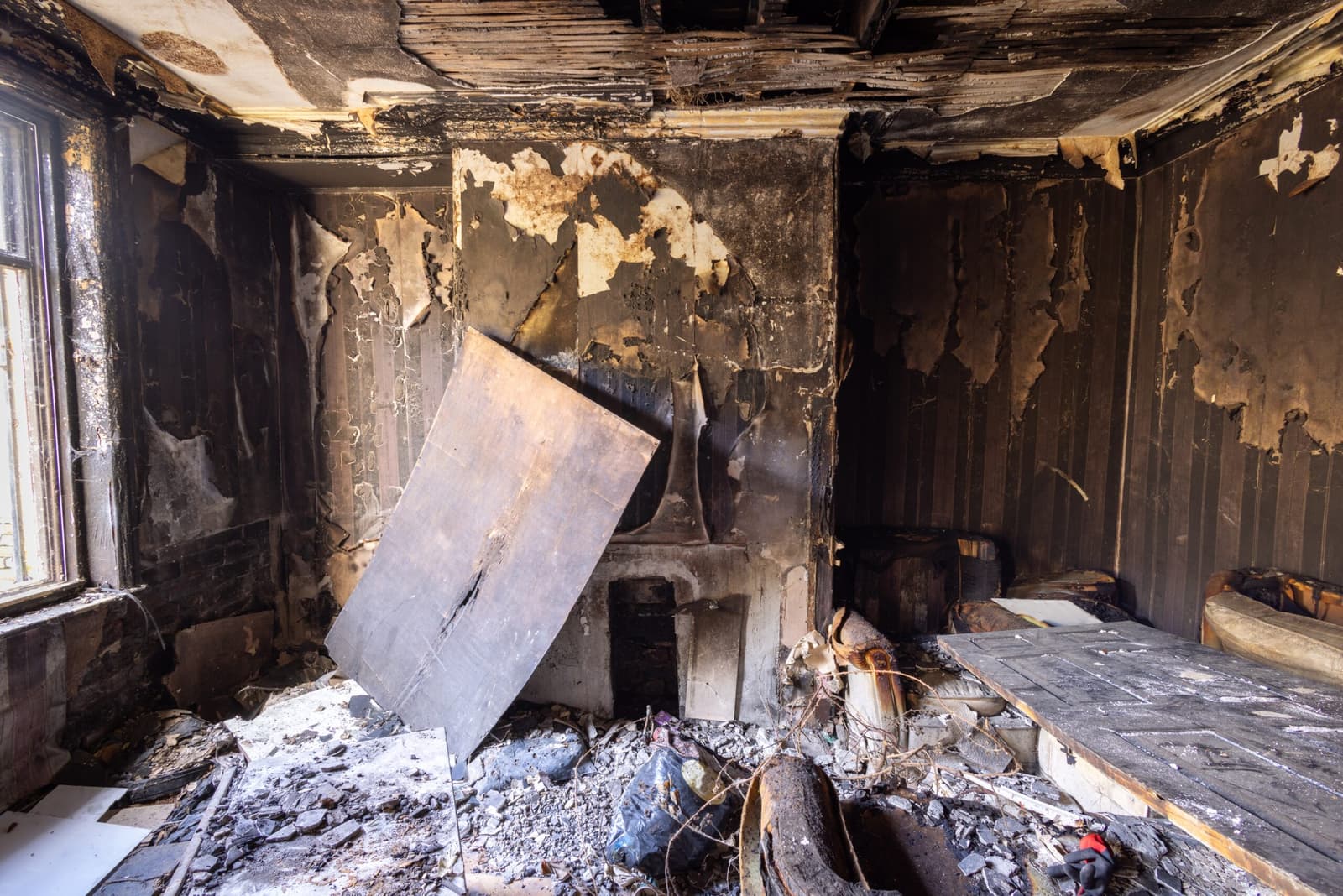
What does a landlord policy pay out after a fire?
Buildings cover reinstates the structure, fixtures and permanent fittings up to the rebuild sum on your schedule. Smoke, heat and firefighting water damage all fall inside the same claim.
What buildings cover reinstates
Landlord buildings insurance covers walls, roof, floors, ceilings, windows and doors, plus the fitted kitchen, the bathroom suite and the boiler. Garages, sheds and boundary walls are usually included, though the limits vary by insurer.
Debris removal and professional fees for architects and surveyors sit inside the same sum insured rather than on top of it. On a full rebuild they can absorb 10% to 15% of the payout before a single brick is laid.
Smoke, heat and firefighting water
A small kitchen fire rarely stays in the kitchen. Smoke gets into every soft surface in the property and firefighting water soaks the rooms below, which is why a fire claim runs far past the visible burn area.
According to the ABI, the average household property claim hit £6,340 in the first quarter of 2026, the highest figure on record and 20% up year on year. Fire claims sit well above that average because so many end as full reinstatements.
Contents, and whose belongings are whose
Landlord contents cover insures the carpets, curtains, white goods and furniture you supplied. Your tenant’s own possessions need tenant contents insurance in their name, not yours.
| Policy section | What it pays for after a fire | Typical limit | Standard or optional |
|---|---|---|---|
| Buildings | Reinstating structure, fixtures and permanent fittings | Rebuild sum insured | Standard |
| Debris removal and fees | Site clearance, architect and surveyor costs | Within the buildings sum | Standard |
| Landlord contents | Carpets, white goods and furniture you provided | £5,000 to £50,000 | Standard on most packages |
| Loss of rent | Rent lost while the property is uninhabitable | Often 20% of the buildings sum | Included or optional |
| Alternative accommodation | Rehousing your tenant during the works | Usually shares the loss of rent limit | Included or optional |
| Property owners’ liability | Injury or third-party damage caused by the fire | £1m to £5m | Standard |
| Malicious damage by tenant | Deliberate ignition by an occupant | Buildings sum, higher excess | Optional |
How likely is a fire in a rented home?
Fire and rescue services in England attended 26,180 dwelling fires in the year to March 2026, of which 23,795 were accidental. That leaves roughly 2,385 started deliberately.
What starts most home fires
Home Office fire statistics put cooking appliances behind 42% of accidental dwelling fires, far ahead of any other source of ignition. Smoking materials cause only 7.6% of them but 27% of the deaths.
| Dwelling fires in England, year to March 2026 | Figure | What it means for a landlord |
|---|---|---|
| Dwelling fires attended | 26,180 | Around one fire per 1,100 homes a year |
| Accidental dwelling fires | 23,795 | Covered as standard on a landlord policy |
| Deliberate dwelling fires | About 2,385 | Needs malicious damage or arson cover |
| Fire deaths in dwellings | 184 | Drives the liability side of a claim |
| Started by cooking appliances | 42% of accidental fires | Kitchen risk dominates |
| Started by smoking materials | 7.6% of fires, 27% of deaths | Small cause, worst outcomes |
| No smoke alarm present | 23% of dwelling fires | The single biggest claim risk |
| Alarm fitted but did not operate | 19% of dwelling fires | Reads as a maintenance failure |
The alarm numbers insurers look at
An alarm worked and raised the warning in only 48% of dwelling fires. In another 19% an alarm was fitted and stayed silent.
That second group is the dangerous one for landlords. A flat battery or a disconnected mains feed is a maintenance failure, and it is the first thing a loss adjuster photographs.
Can your insurer refuse a fire claim?
It can, but a reduced settlement is far more common than an outright refusal. Most disputed fire claims turn on a safety duty you cannot evidence rather than on how the fire started.
The exclusions that bite
- Wear and tear, or a fault you were told about and left unrepaired.
- Gradual smoke staining from cigarettes or candles, which is damage over time rather than one event.
- Your tenant’s own possessions, which you have no insurable interest in.
- Damage after the property has stood empty beyond the unoccupancy limit without telling the insurer.
- Deliberate damage by you, or by anyone acting on your instructions.
How a safety breach changes the payout
Insurers rarely argue that a missing smoke alarm caused the fire. They argue that it made the damage worse, or that you answered a compliance question on the proposal form incorrectly.
Where the misrepresentation was careless rather than deliberate, the usual outcome is a proportionate reduction rather than a void policy. The same principles that invalidate a home insurance policy apply to a let property.
Deliberate or reckless misstatement is treated differently. The insurer can act as though the policy never existed and keep the premiums you paid.
| Safety duty | What the law requires | Maximum penalty | Effect on a fire claim |
|---|---|---|---|
| Smoke alarms | One per storey used as living accommodation, tested on day one of the tenancy | £5,000 | Reduction where the absence worsened the damage |
| Carbon monoxide alarms | One in any living room containing a fixed combustion appliance other than a gas cooker | £5,000 | Reduction, plus a liability exposure |
| Electrical report | An EICR at least every five years by a qualified person | £30,000 | Strong ground for reduction if wiring started the fire |
| Furniture labelling | Fire-resistant labelled upholstery in any furnished let | Prosecution by Trading Standards | Reduction where an unlabelled item ignited or spread the fire |
| Fire risk assessment | Recorded assessment of the common parts of an HMO or block | Unlimited fine | Usually an express policy condition, so a breach of contract too |
| HMO licence | Required for five or more occupiers from two or more households sharing facilities | Unlimited fine | Undeclared HMO use can void the policy outright |
What are your legal fire safety duties as a landlord?
Smoke alarms on every storey, a carbon monoxide alarm beside any fixed combustion appliance, an electrical report every five years and fire-resistant furniture in a furnished let. HMOs and blocks of flats carry a recorded fire risk assessment on top of all that.
Smoke and carbon monoxide alarms
The Smoke and Carbon Monoxide Alarm (England) Regulations 2015, as amended in 2022, set two duties. The government’s guidance for landlords states them plainly: one smoke alarm on every storey with a room used as living accommodation, and a carbon monoxide alarm in any such room containing a fixed combustion appliance other than a gas cooker.
You must check that every alarm works on the day a new tenancy begins, and repair or replace a faulty one once the tenant tells you about it. A local authority can impose a penalty of up to £5,000 for a breach.
A fixed combustion appliance means a boiler, a gas fire, a solid fuel stove or a wood burner. Ask a registered gas engineer to confirm what counts before you decide where the alarm goes.
Electrical safety and the five-year report
The Electrical Safety Standards in the Private Rented Sector (England) Regulations 2020 require an Electrical Installation Condition Report at least every five years, carried out by a qualified electrician. Regulation 11 lets a council impose a penalty of up to £30,000 for each breach.
Keep the report itself and the invoices for any remedial work in the same file. After a fire that started in the wiring, that paperwork separates a paid claim from an argued one.
Furniture in a furnished let
The Furniture and Furnishings (Fire) (Safety) Regulations 1988 still apply to every sofa, mattress, headboard and scatter cushion you supply. Each item needs its permanent fire-safety label attached.
Unlabelled second-hand furniture is the most common breach and the easiest one to spot after a fire. Underwriters ask about it directly on student and HMO proposal forms.
HMOs and blocks of flats
The Regulatory Reform (Fire Safety) Order 2005 makes you the responsible person for the common parts of an HMO or a block of flats. Since 1 October 2023 the fire risk assessment must be recorded in full whatever the size of the building, and the government’s fire safety guidance for blocks of flats is written around that duty.
Fire doors, emergency lighting, protected escape routes and a linked alarm system all flow from that assessment. HMO insurance normally carries them as express policy conditions, so a lapsed assessment breaches your contract as well as the law.
Are you covered if a tenant starts the fire?
An accidental fire started by a tenant is covered like any other fire. Deliberate ignition is a separate question, handled under the malicious damage section rather than the fire peril.
Accidental ignition by a tenant
A chip pan, an overloaded extension lead or a candle left burning are accidents in insurance terms. Your buildings cover responds, and your insurer may then pursue the tenant for the cost.
Accidental damage cover is a different section aimed at one-off mishaps that are not on the insured perils list. Fire is already on that list, so you do not need the extension to claim for a burnt-out kitchen.
Arson and malicious ignition
Around 2,385 dwelling fires in England were recorded as deliberate in the year to March 2026. A minority were set by occupants, often during a dispute or a pending possession claim.
Malicious damage by tenants is an optional extension on most buy-to-let policies and is excluded by default on the cheapest ones. Where it is included, expect a higher excess and a condition that you report the incident to the police.
Arson by a third party, such as a break-in that ends in a fire, is normally covered as standard. The distinction insurers draw is who lit it, not how bad it got.
Does insurance replace the rent while the property is rebuilt?
Loss of rent cover pays the rent you would have collected while the property is uninhabitable, provided an insured event caused the damage. It is included on some landlord packages and optional on others, so read the schedule rather than assuming.
Loss of rent cover
Loss of rent cover is usually capped at a percentage of the buildings sum insured, commonly 20%, with an indemnity period of 12 to 36 months. On a £250,000 rebuild sum that is £50,000 of rent, more than most single lets will ever need.
It is not the same thing as rent guarantee insurance, which pays out when a tenant stops paying. Loss of rent needs insured damage first, so an empty property with no fire gets you nothing.
Rehousing your tenant
Alternative accommodation cover pays to house your tenant while the work is done and usually shares a limit with loss of rent. Once the property is stripped back and empty, tell your insurer, because unoccupied property rules start to apply.
Most policies restrict cover after 30 to 45 consecutive days empty. Reinstatement work does not always count as occupation, so ask before the builders start.
| Fire severity | Typical reinstatement time | Rent lost on a £1,200 a month let | Cover that responds |
|---|---|---|---|
| Smoke damage to one room | 4 to 8 weeks | £1,100 to £2,200 | Buildings plus loss of rent |
| Kitchen fire with water damage below | 3 to 6 months | £3,600 to £7,200 | Buildings, contents and loss of rent |
| Half the property, roof intact | 6 to 12 months | £7,200 to £14,400 | All sections plus alternative accommodation |
| Total loss and full rebuild | 12 to 24 months | £14,400 to £28,800 | Rebuild sum, capped by the indemnity period |
How do you claim for fire damage?
Call the insurer the same day, keep the property secure and change nothing until a loss adjuster has seen it. Fire claims are almost always adjusted in person rather than settled on paperwork.
The first 48 hours
- Check everyone is out and wait for the fire service to release the property.
- Report the claim by phone the same day, before you speak to a builder.
- Photograph and film every room, including the ones that only smell of smoke.
- Board up openings and isolate the gas, water and electrics.
- Keep receipts for emergency boarding, hotels and travel.
- Throw nothing away until the adjuster has inspected it.
What the loss adjuster will want
Expect to hand over the gas safety record, the EICR, your alarm test evidence and the tenancy agreement. On an HMO, the recorded fire risk assessment and the licence come next.
The fire service report on the cause usually follows within a few weeks. Insurers wait for it before authorising a large reinstatement.
Getting the rebuild sum right
Fire is the one peril that regularly produces a total loss, which is exactly when underinsurance surfaces. If your buildings sum insured is short, the insurer can cut the settlement in proportion.
Insure for rebuild cost, not market value. A £280,000 terrace often rebuilds for nearer £190,000, and paying to insure the higher figure buys you nothing.
Frequently Asked Questions (FAQs)
Yes. Fire, lightning and explosion form the base set of insured perils on every landlord buildings policy, so no extension is needed.
Not automatically, but the insurer can reduce the settlement if the missing alarms made the damage worse. A council can also fine you up to £5,000 for the breach itself.
No. Buildings cover protects the structure and contents cover protects what you supplied, so your tenant needs a policy of their own.
Only if you bought malicious damage by tenants, which is optional on most policies. You will normally need a police reference and a higher excess applies.
It pays up to the rebuild sum on your schedule. Set that figure below the real rebuild cost and the insurer can scale the settlement down proportionately.
Cover is usually restricted after 30 to 45 consecutive days empty. Tell the insurer the day the tenancy ends and ask for the unoccupancy terms in writing.
A single smoke-damaged room can settle in six to eight weeks. A full rebuild commonly runs 12 to 24 months from the first call to the final invoice.
The Fire Safety Order applies to common parts of shared buildings rather than a self-contained house. You still need the alarms, the EICR and safe furniture.
Yes. Solid fuel appliances change the risk, and an undeclared wood burner is one of the most common reasons a fire claim gets reduced.
It is usually covered, but insurers expect proof of annual sweeping. Keep the sweep’s certificate with your other safety records.
Yes, if it followed an insured fire. Specialist deodorising and sealing work is a recognised head of claim on buildings cover.