
Does Landlord Insurance Cover Subsidence?


Yes. Subsidence, heave and landslip are standard perils on almost every landlord buildings policy sold in the UK, but the excess is normally £1,000 rather than the £100 to £500 you pay on a fire or leak claim.
Ground movement cover is unusual by international standards, and UK insurers bundle subsidence, heave and landslip into a single section of landlord buildings insurance. What varies between insurers is not whether you are covered, but the excess, the disclosure duties and how long the claim runs.
The Association of British Insurers put the average domestic subsidence claim at a record £20,000 in the second quarter of 2026, with £72 million paid out in those three months. A landlord policy is the only thing standing between you and that bill.
Subsidence, heave and landslip come as standard on almost every landlord buildings policy sold in the UK, so the question is rarely whether you’re covered. The excess is the sting, because ground movement carries a much higher one than a fire or leak claim. If a tenant reports cracks, photograph and date them, report it early and let the insurer arrange any monitoring rather than commissioning your own. Declare past movement when you renew or switch, because staying with the insurer that handled the claim is usually simpler than moving.
Compare landlord buildings insurance quotes and check the subsidence excess before you buy.
- What does the subsidence section of a landlord policy pay for?
- How is subsidence different from heave and settlement?
- Why have subsidence claims hit a record in 2026?
- What should you do if a tenant reports cracks?
- How long does a subsidence claim take and what do repairs cost?
- Who pays if you switched insurer before the cracks appeared?
- Can you still insure a property that has had subsidence?
- Frequently asked questions (FAQs)
What does the subsidence section of a landlord policy pay for?
It pays to stabilise the building and return it to its pre-damage condition, including investigation, underpinning, structural repair and the redecoration that follows. It will not pay to improve the property or to fix movement that started before your policy did.
What you are covered for
- Investigation costs, including the loss adjuster, the structural engineer and any site monitoring the claim needs
- Underpinning, resin injection or piling where the engineer’s report calls for it, plus the drainage or tree works that go with it
- Making good afterwards: replastering, redecorating and refitting kitchens or bathrooms damaged by the movement
- Loss of rent while the property is uninhabitable, and alternative accommodation for your tenant where the tenancy makes you responsible
Letting a leasehold flat changes who claims rather than whether you are covered. The freeholder’s block of flats policy carries the structure, and you pick up a share of the excess through the service charge.
What is left out
- Movement that began before the policy started, which is the single most common reason a subsidence claim is declined
- Normal settlement in a new build, and shrinkage cracking in fresh plaster or render
- Damage traced to defective foundations, poor workmanship or an extension built without approval
- Boundary walls, garden walls, paths, drives and patios, unless the main building is damaged at the same time
- A known subsidence history that was never declared, which invalidates the whole policy rather than just the subsidence section
Why the excess is ten times bigger
The compulsory subsidence excess sits at £1,000 across most of the market, against £100 to £500 on other buildings claims. High-risk postcodes and properties with a claims history are routinely loaded to £2,500 or £5,000.
The excess applies per claim, so a second episode of movement means paying it again. Almost every buy-to-let mortgage makes buildings cover a condition of the loan, so dropping the section is rarely an option even if an insurer offered it.
How is subsidence different from heave and settlement?
Subsidence is the ground sinking away beneath your foundations, heave is the ground swelling and pushing them up, and settlement is the slow, even compression every new building goes through. Insurers pay for the first two and never for the third.
Telling the four apart
| Ground movement | What happens | Usual trigger | Insured? |
|---|---|---|---|
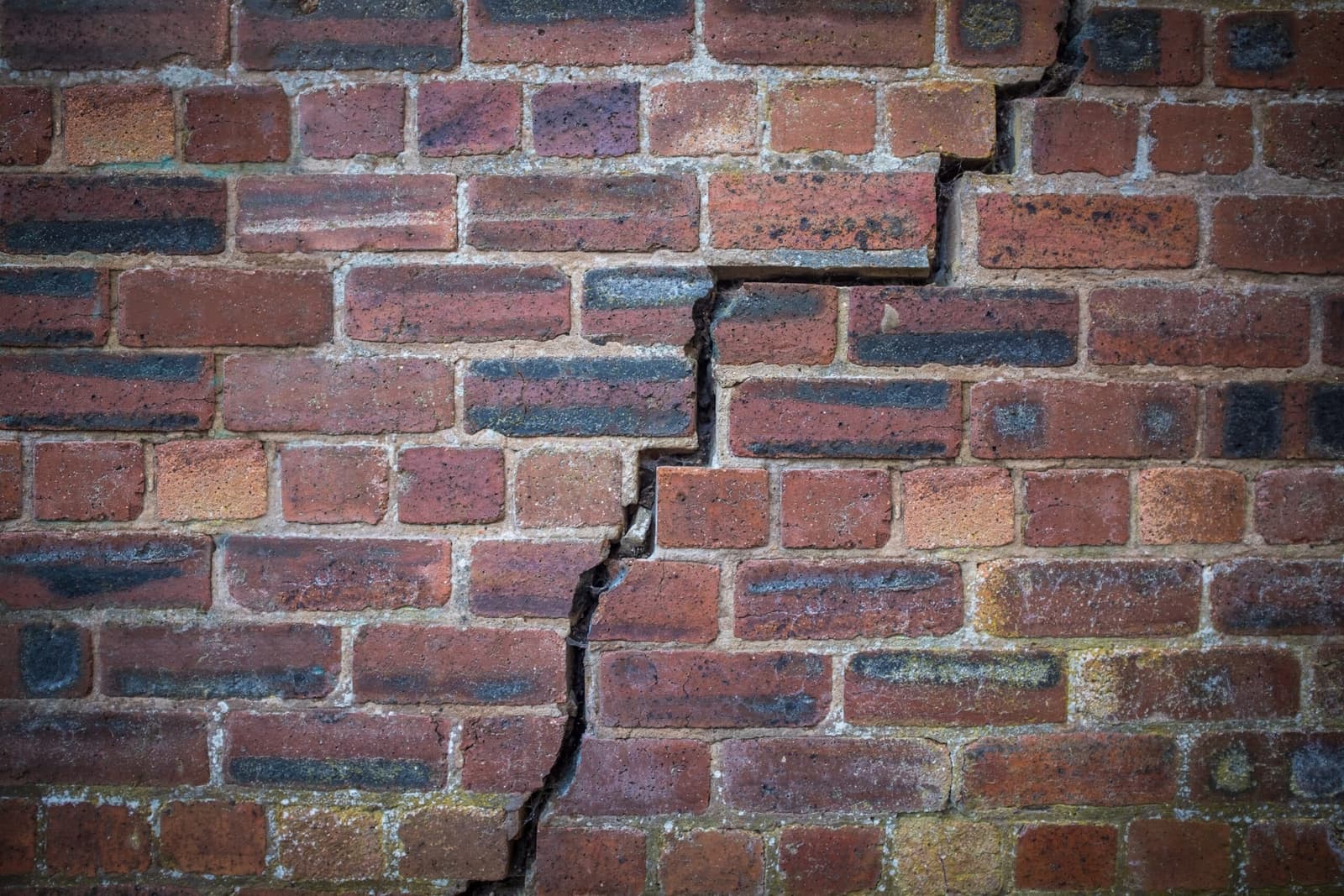
| Subsidence | Foundations drop unevenly and walls crack diagonally | Clay shrinkage, tree roots, leaking drains, old mine workings | Yes, standard peril |
| Heave | Foundations are pushed upward, cracks are wider at the bottom | Clay reabsorbing water, often after a large tree is felled | Yes, standard peril |
| Landslip | A whole section of ground slides down a slope | Saturated sloping ground, coastal erosion, made ground | Yes, standard peril |
| Settlement | The building beds down evenly and stops within a few years | New foundations compressing the soil under their own weight | No, treated as normal |
Why felling a tree can make it worse
A mature oak or willow can draw hundreds of litres of water a day out of clay soil. Cut it down and the clay reabsorbs that moisture, swells, and pushes back up the foundations it spent ten dry summers pulling down.
Crown reduction is usually the safer route, and a structural engineer should sign off any tree work near an affected building. Where the tree belongs to a neighbour or the council, legal expenses cover is what funds the argument about who pays.
Why have subsidence claims hit a record in 2026?
England and Wales recorded their warmest spring on record in 2026, and soil moisture deficits reached the top of the measurable scale faster than in any year since 2003. Insurers reported subsidence notifications up more than 500% in August against earlier months.
The clay shrinkage cycle
The British Geological Survey ranks shrink-swell clay as the most damaging ground hazard in Britain. Clay loses volume as it dries out, and anything founded on it drops unevenly.
The MORECS soil moisture deficit hit 308.2 in summer 2026, its maximum measurable value. Because 2025 never let the ground fully recover, the 2026 surge arrived earlier and harder than the last one.
How 2026 compares with earlier surge years
2018, 2022 and 2026 are the modern surge years, each following an exceptionally dry spring and summer. The ABI counted 23,000 subsidence claims in 2022 worth £219 million, the highest annual payout since 2006.
The average claim in 2022 was around £9,600. Four years later it is £20,000, driven by building cost inflation and a shortage of subsidence engineers rather than worse damage.
Which parts of the UK carry the risk
| Area | Dominant ground condition | Why it moves | Risk |
|---|---|---|---|
| Greater London | London Clay | High shrink-swell clay plus dense mature street trees | Very high |
| Essex, Kent, Surrey, Sussex | London, Weald and Gault Clay | Shrink-swell clay under the driest summers in the UK | Very high |
| Oxfordshire, Bucks, Northants | Oxford and Kimmeridge Clay | Shrink-swell clay in a low-rainfall belt | High |
| Cambs, Beds, Norfolk | Gault Clay and peat over chalk | Clay shrinkage plus peat wastage from field drainage | High |
| Notts, Derbys, South Yorkshire | Former coalfields | Historic mine workings and unstable backfill | Moderate to high |
| South Wales valleys | Coal measures and made ground | Old workings, tipped ground and steep slopes | Moderate |
| Northern England, Scotland | Glacial till, rock near the surface | Little shrink-swell clay and wetter summers | Low |
Landlords with several houses in the same clay belt carry a correlated risk, because one dry summer can crack all of them at once. A portfolio landlord policy will not remove that, but it does give you one insurer to argue with instead of four.
What should you do if a tenant reports cracks?
Photograph and date the cracks, then notify your insurer the same week. Waiting for a builder’s opinion before you tell the insurer is the most common way landlords weaken a subsidence claim.
The first week
- Photograph every crack with a coin or ruler for scale, and record the room, the wall and the date on each image
- Measure the widest point. Diagonal cracks over 3mm that are wider at one end and visible inside and out are the ones insurers act on
- Notify the insurer before instructing anyone. Most policies require prompt notification, and unauthorised works can be refused later
- Ask the tenant to report any change in doors, windows or floors in writing, and to leave the cracks unfilled until the adjuster has seen them
- Keep receipts for emergency work, temporary accommodation and any rent you refund, because all three can form part of the claim
What you owe the tenant meanwhile
Structural collapse and falling elements is one of the 29 hazards a council assesses under the Housing Health and Safety Rating System. A serious structural hazard can trigger an improvement notice whatever stage your claim has reached.
If the property becomes unsafe, loss of rent cover usually pays for 12 to 24 months while repairs run. That is a different section from rent guarantee insurance, which responds to a tenant who stops paying rather than to insured damage.
How long does a subsidence claim take and what do repairs cost?
Three to six months is realistic where the cause is obvious and the fix is cosmetic. Anything needing monitoring or underpinning runs 12 to 18 months, and the 2026 claim queue has pushed that out further.
The monitoring year
Insurers rarely authorise underpinning without evidence that the movement is still active. Level monitoring, crack gauges and borehole sampling normally run across a full seasonal cycle of 12 months.
That cycle is why claims stall over winter with nothing visible happening. A property that cracked in August 2026 may not get a repair decision until autumn 2027.
What each repair method costs
| Repair approach | Typical cost | When it is used | Time on site |
|---|---|---|---|
| Crack repair and redecoration | £2,000 to £5,000 | Movement has stopped and the damage is cosmetic | 1 to 2 weeks |
| Tree removal or crown reduction | £1,000 to £5,000 | Roots are the identified cause and heave risk is low | 2 to 5 days |
| Drain repair or relining | £2,000 to £8,000 | A leaking drain has washed subsoil out from under the footings | 1 to 3 weeks |
| Resin injection | £6,000 to £16,000 | Moderate movement where the tenant can stay put | 1 to 2 weeks |
| Mass concrete underpinning | £10,000 to £25,000 | A section of foundation has dropped and needs rebuilding below | 6 to 12 weeks |
| Mini-piled underpinning | £15,000 to £40,000 | Deep or poor ground, or a large or listed property | 8 to 16 weeks |
Listed buildings and conservation areas add roughly 20% to 40% to those figures once specialist contractors and consent applications are counted. If the house stands empty through months of works, tell your insurer and check whether unoccupied property cover needs to sit alongside the claim.
Who pays if you switched insurer before the cracks appeared?
The ABI Domestic Subsidence Agreement decides that between the insurers, not you. Which one settles depends on how long your new policy had been running when the damage was reported.
The eight week and twelve month rules
| Time since you switched | Who handles the claim | Who pays for it |
|---|---|---|
| Under 8 weeks | Your previous insurer | Previous insurer settles in full |
| 8 weeks to 12 months | Either insurer, agreed between them | Split 50/50, with the contribution paid within 21 days |
| Over 12 months | Your current insurer | Current insurer settles in full |
You deal with one insurer either way and they settle the split behind the scenes. The agreement only bites where cover has been continuous, so a gap between policies leaves you outside it entirely.
Why switching mid-claim backfires
An open or historic subsidence claim has to be declared on every quote you ask for, and the Consumer Insurance (Disclosure and Representations) Act 2012 governs what happens if you get it wrong. A careless answer lets the insurer reduce the claim proportionately, and a deliberate one voids the policy from day one.
If a claim is refused and the insurer’s own complaints process gets you nowhere, the Financial Ombudsman Service can order it to settle. Its decision binds the firm once you accept it, and the service is free to use.
Can you still insure a property that has had subsidence?
Yes, usually through a specialist underwriter rather than a mainstream insurer, and with a subsidence excess of £2,500 to £5,000. Expect to produce the engineer’s completion paperwork before anyone quotes.
What underwriters ask for
- The loss adjuster’s final report and the certificate of structural adequacy issued when the repair signed off
- Confirmation of what was done: underpinning, resin, drainage repair, tree works or a combination
- Monitoring data showing movement has stopped, normally covering at least 12 months since the repair
- The full claims history for the address, not just the years you have owned it
Insurers who write non-standard property risks take this every day, and a broker will reach the ones that never appear on comparison sites.
What it does to resale and to rental demand
A repaired and certified property typically sells 5% to 20% below an equivalent house with no history. The buyer’s surveyor will flag it and their lender will ask for the same paperwork your insurer wanted.
Rental demand barely moves once the repairs are signed off, because tenants are not buying the building. Holding a certified property and letting it often beats selling into a discounted market.
Frequently Asked Questions (FAQs)
Only where the cracking is caused by an insured peril such as subsidence, heave or landslip. Hairline cracks from normal drying, thermal movement or plaster shrinkage are maintenance.
Expect a loading of roughly 30% to 100% for the first few years, plus a raised subsidence excess. The claim stays on your record for five years and has to be declared on every quote after that if the insurer asks.
Yes, and mainstream insurers frequently do. The Domestic Subsidence Agreement covers who pays for the current claim, not whether anyone has to keep insuring you.
Usually not on their own. Most landlord policies only pay for boundary walls, paths and drives when the main building is damaged by the same event.
Yes, once you know. You cannot let a property with a known unrepaired structural hazard and stay on the right side of your repairing obligations.
The claim still goes to your own insurer first. Your insurer can then pursue the tree owner, which is where the argument over a council street tree usually starts.
Order a ground stability or environmental search alongside the survey, and ask the seller directly about past claims. Mature trees within their own height of the building are the obvious red flag on clay.
The freeholder’s block policy handles the structure, so the claim runs through the managing agent. Your own policy still covers your contents, your liability and your lost rent.
Not always. Where the cause is a leaking drain or an obvious tree and the damage is limited, insurers will often fix the cause and repair the cracks without a full monitoring cycle.
Your policy will not pay for damage that pre-dates it, which is why the seller’s disclosure and the survey matter so much. If it was repaired and certified, the certificate is what makes the property insurable.