
What Are the Fire Safety Requirements for Landlords?


Landlords in England must fit a smoke alarm on every storey with a habitable room, a carbon monoxide alarm in every room holding a fixed combustion appliance other than a gas cooker, and supply only fire-resistant upholstered furniture. Any property with common parts, from a two-flat conversion upwards, also needs a written fire risk assessment.
Those duties come from four separate pieces of law rather than one fire safety code. Which of them bite depends on whether you let a whole house, a shared HMO or a flat inside a block.
Getting any of them wrong costs more than the fine. Most landlord insurance policies make fire safety compliance a condition of cover, so a breach can turn a paid claim into a declined one.
In England you need a smoke alarm on every storey with a habitable room and a carbon monoxide alarm in every room holding a fixed combustion appliance other than a gas cooker. Any upholstered furniture you supply has to be fire resistant, and a property with common parts needs a written fire risk assessment, from a two-flat conversion upwards. HMOs carry extra duties and the rules differ in Scotland, Wales and Northern Ireland, so log each test with a date and keep the records with your certificates.
Compare landlord insurance quotes and tell your insurer what fire precautions are in place.
- What alarms must you fit and where?
- Do you need a fire risk assessment?
- What fire safety rules apply to an HMO?
- Does the furniture you supply have to be fire resistant?
- What applies to a single let, an HMO and a block of flats?
- How do the rules differ in Scotland, Wales and Northern Ireland?
- What are the penalties for getting fire safety wrong?
- How often should you test and what should you record?
- Frequently asked questions (FAQs)
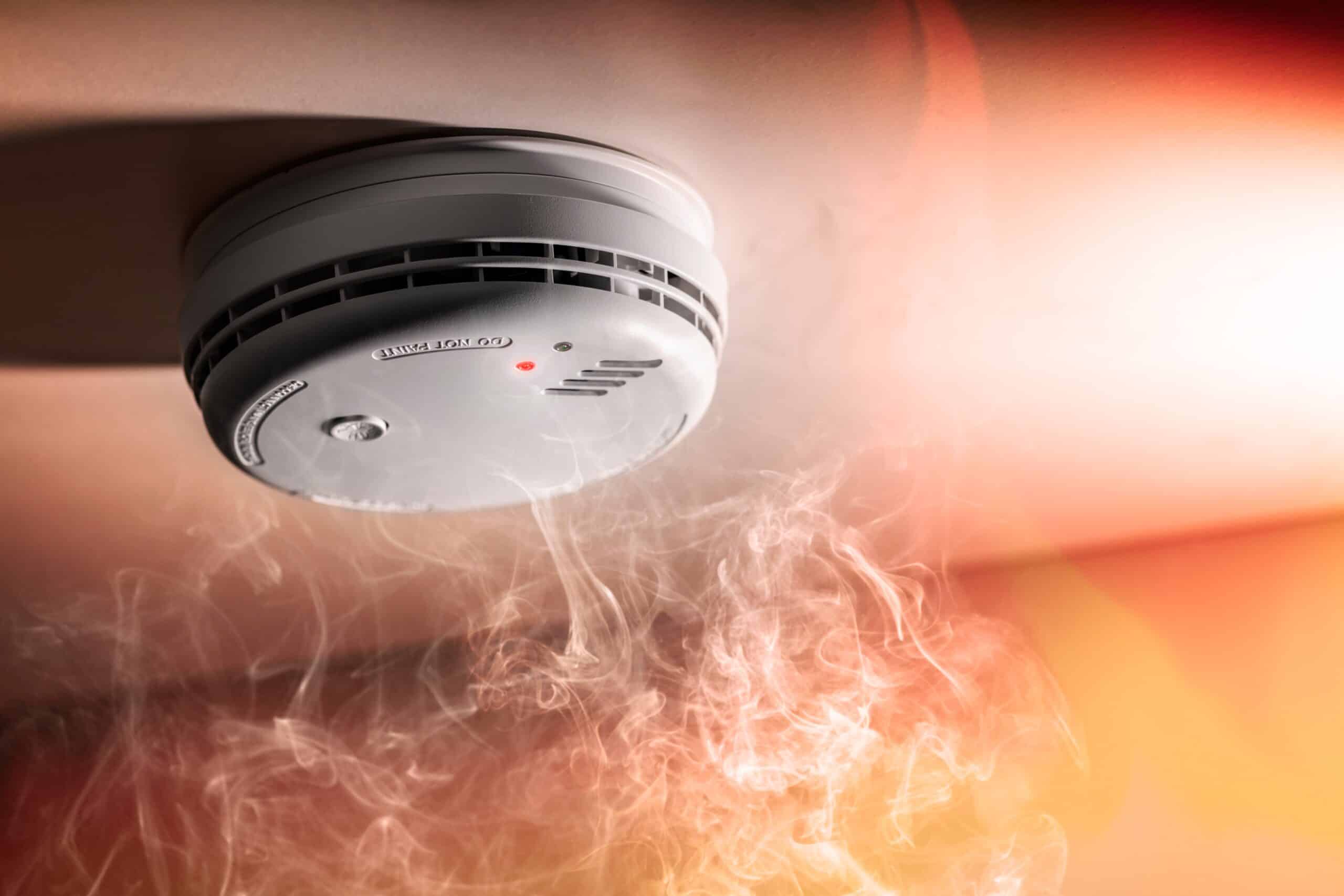
What alarms must you fit and where?
One working smoke alarm on every storey that contains a room used as living accommodation, plus a carbon monoxide alarm in every room containing a fixed combustion appliance other than a gas cooker. Both have to be tested on the first day of the tenancy.
How many alarms each storey needs
The Smoke and Carbon Monoxide Alarm (England) Regulations 2015 set the duty at storey level, not room level. A three-storey house with a habitable room on each floor needs three smoke alarms as a minimum, and a habitable loft conversion counts as a storey.
Carbon monoxide alarms are counted per room instead. A boiler in the kitchen and a wood burner in the lounge means two alarms, each sited one to three metres from the appliance.
What the 2022 amendment changed
Before 1 October 2022 a carbon monoxide alarm was only needed where there was a solid fuel appliance. The amendment extended it to every fixed combustion appliance, so gas boilers, oil boilers and gas fires are now in scope, as the government’s alarm guidance for landlords confirms.
The same amendment added a repair duty and pulled social landlords into the rules. If a tenant reports an alarm that is not working, you repair or replace it as soon as reasonably practicable rather than at the next inspection.
A further tidy-up on 1 May 2026 stripped the assured shorthold tenancy wording out of the regulations. The duties themselves did not change; they now read across to the periodic assured tenancies created by the Renters’ Rights Act 2025.
What happens if you ignore a remedial notice?
The council serves a remedial notice giving you 28 days to fit or fix the alarms. Ignore it and it can impose a penalty charge of up to £5,000 and arrange the work itself at your expense.
There is no fine for the original breach, only for failing to answer the notice. A gas engineer servicing the boiler will usually site the carbon monoxide alarm for you, which makes this the cheapest duty on the list to meet.
Do you need a fire risk assessment?
If the property has any common parts, yes, and since 1 October 2023 the assessment must be written down in full. A self-contained house let to a single household is the main case that escapes the duty.
Which properties have common parts?
A shared hallway, a communal stair, a bin store or a shared entrance lobby all count. That catches every HMO, every converted house of two or more flats and every purpose-built block, however small.
Under the Regulatory Reform (Fire Safety) Order 2005 you are the responsible person for those areas, and the government’s guidance on fire safety in purpose-built blocks of flats sets the benchmark. Inside a single self-contained flat the Order falls away, because that space counts as domestic premises.
What the recorded assessment must contain
Section 156 of the Building Safety Act 2022 removed the old five-employee threshold on 1 October 2023. Every responsible person now records the assessment in full, naming the person or organisation who carried it out.
The assessment covers ignition sources, fuel loads, how fire and smoke would spread, the escape route and the measures already in place. Fire and rescue inspectors ask for it first and judge the rest of your compliance by its quality.
What does a fire risk assessment cost?
A competent assessor charges roughly £150 to £500 depending on size and complexity. A three-storey shared house sits around £250 to £400, and a small block of flats lands in much the same range.
Review it when something changes rather than on a fixed calendar, because the Order requires a review once the assessment is no longer valid. New occupancy, a layout change, a loft conversion or a near miss are all triggers.
What fire safety rules apply to an HMO?
An HMO carries the alarm rules, the Fire Safety Order and a separate set of management duties on top. In practice that means an interlinked detection system, fire doors with self-closers onto the escape route, and a protected route to the front door.
What alarm grade does your HMO need?
Shared houses of up to two storeys usually need a Grade D1 LD3 system, meaning mains-powered detectors with sealed backup batteries covering the escape route. Three storeys or more, or bedsit-style letting with locks on bedroom doors, pushes you to a Grade A LD2 panel system, which is why HMO insurance underwriters ask what is fitted.
Councils set the exact specification as a licence condition and they vary between areas. Ask the licensing team for their written standard before you spec the system, not after.
Fire doors, escape routes and self-closers
Doors from habitable rooms onto the escape route should be FD30 rated and fitted with a self-closing device. Thirty minutes of resistance is the standard because it buys the time a protected stair is designed to give.
The final exit door must open from the inside without a key, so thumb-turn locks replace deadlocks. Escape routes stay clear of bikes, buggies and stored furniture, and an electrician tests any emergency lighting on the route once a year.
The management duty most HMO landlords miss
Regulation 4 of the Management of Houses in Multiple Occupation (England) Regulations 2006 is a separate criminal duty made under the Housing Act 2004. It requires escape routes to be kept free from obstruction and in good repair, and fire alarms and firefighting equipment to be maintained in working order.
It also requires notices showing the escape route in any HMO with five or more occupiers. Councils prosecute on this regulation far more often than on the Fire Safety Order, because the evidence is a photograph of a blocked hallway.
Licensing sits separately again, and an HMO licence is mandatory at five or more occupiers from two or more households. Letting an unlicensed HMO risks a civil penalty of up to £30,000 or prosecution with an unlimited fine.
Does the furniture you supply have to be fire resistant?
Yes. Every piece of upholstered furniture and soft furnishing you provide must meet the Furniture and Furnishings (Fire) (Safety) Regulations 1988, and supplying anything that does not is a criminal offence.
Which items are covered
The 1988 Regulations catch sofas, armchairs, beds, mattresses, divans, headboards, scatter cushions and seat pads. Second-hand items bought for a let are held to the same standard as new ones.
Anything the tenant brings themselves sits outside the rules. Record who supplied what in the inventory so the line is clear, and remember that landlord contents cover only insures the items you own.
What changed on 30 october 2025
The 2025 amendment removed the display swing label from new furniture and from the second-hand market. The permanent label sewn into the item stayed, and that is the one to check before an item goes into a property.
The same amendment took cots, cribs, prams, pushchairs, car seats and play mats out of scope. It also extended the window for bringing a prosecution from six months to twelve.
What the penalty is now
The often-quoted £5,000 ceiling no longer applies in England and Wales, where level 5 fines became unlimited in March 2015. A conviction can also carry up to six months in prison.
Trading standards enforces this rather than the council’s housing team. No label and no paperwork means you cannot prove compliance, so replace the item rather than argue about it.
What applies to a single let, an HMO and a block of flats?
A single self-contained let needs alarms and compliant furniture and little else. Add common parts and the Fire Safety Order applies, and add shared occupancy and the HMO management duties stack on top.
The three regimes side by side
| Duty | Single self-contained let | HMO | Block of flats |
|---|---|---|---|
| Smoke alarm on each storey | Yes | Yes | Yes, inside each flat |
| CO alarm per combustion appliance | Yes | Yes | Yes, inside each flat |
| Fire-resistant furniture you supply | Yes | Yes | Yes |
| Recorded fire risk assessment | Only if there are common parts | Yes | Yes, for the common parts |
| Interlinked detection to BS 5839-6 | Not required | Grade D1 LD3 up to Grade A LD2 | Common parts system as assessed |
| FD30 doors with self-closers | Not required | Yes, onto escape routes | Flat entrance and common parts doors |
| Emergency lighting | Not required | Where the escape route needs it | Where the escape route needs it |
| Escape route notices | Not required | Yes at five or more occupiers | Usually yes |
| Quarterly fire door checks | Not required | Not required | Yes above 11 metres |
Higher-risk blocks under the building safety act
A building at least 18 metres tall or with at least seven storeys, containing two or more residential units, is a higher-risk building under the Building Safety Act 2022. Registering it with the Building Safety Regulator and holding a safety case report is a freeholder duty rather than a buy-to-let landlord one.
If you own a flat in one of those buildings, your obligations run through the lease and the service charge. Ask the managing agent for the current fire risk assessment and the building’s registration status before you buy.
Buildings over 11 metres carry quarterly checks of common parts fire doors and yearly best-endeavours checks of flat entrance doors under the Fire Safety (England) Regulations 2022. Those duties sit with whoever arranges the block of flats policy, normally the freeholder or the residents’ management company.
Mixed use and short lets
A flat above a shop puts the commercial floor under the Fire Safety Order in its own right. The fire strategy has to treat the building as a whole, which is why commercial property insurance usually sits alongside the residential policy.
Short-term and holiday letting is treated as non-domestic, so the Order applies to the whole unit rather than only the common parts. That means a written assessment for every property you list, and Airbnb cover rather than a standard let policy.
How do the rules differ in Scotland, Wales and Northern Ireland?
England asks the least of the four nations on alarms. Scotland requires interlinked alarms and a heat alarm in the kitchen, Wales requires mains-wired interlinked smoke alarms on every storey, and Northern Ireland has no direct private-tenancy equivalent at all.
Scotland’s interlinked alarm standard
Since February 2022 every Scottish home has needed a smoke alarm in the most-used room, one in each hallway and landing, and a heat alarm in the kitchen. All of them must be ceiling-mounted and interlinked so that one triggers the rest.
A carbon monoxide alarm is needed in any room with a carbon-fuelled appliance, and gas cookers are again excluded. The duty falls on the owner, so it applies whether the property is let or standing empty.
Wales under the renting homes regime
Wales folds fire safety into the fitness for human habitation rules that apply to occupation contracts. A dwelling is treated as unfit if it lacks a working smoke alarm on each storey that is wired to the mains and linked to the others.
The Welsh carbon monoxide rule is wider than England’s. An alarm is required in every room containing a gas appliance, an oil-fired appliance or a solid fuel appliance, with no carve-out for gas cookers.
Northern Ireland’s position
Northern Ireland has no equivalent of the England 2015 alarm regulations for private tenancies. Smoke alarm provision comes through the building regulations when a property is built or materially altered, so older stock can be legally under-equipped.
HMO fire safety is a different matter and is licensed across Northern Ireland through a single scheme. Fitting the England standard voluntarily is the sensible baseline, and it is what most multi-property insurers expect to see on a schedule.
| Nation | Smoke alarms | Carbon monoxide alarms | Source of the duty |
|---|---|---|---|
| England | One per storey with a habitable room, interlinking optional | Every room with a fixed combustion appliance except a gas cooker | Smoke and Carbon Monoxide Alarm (England) Regulations 2015 |
| Scotland | Most-used room, every hall and landing, plus a kitchen heat alarm, all interlinked | Every room with a carbon-fuelled appliance except a gas cooker | Tolerable standard under the Housing (Scotland) Act 1987 |
| Wales | One per storey, mains-wired and interlinked | Every room with a gas, oil-fired or solid fuel appliance, gas cookers included | Renting Homes (Fitness for Human Habitation) (Wales) Regulations 2022 |
| Northern Ireland | No private-tenancy duty, building regulations apply to new and altered homes | No private-tenancy duty | Building regulations, plus HMO licensing for shared houses |
What are the penalties for getting fire safety wrong?
Fines run from a £5,000 penalty charge for ignoring an alarm remedial notice up to an unlimited fine and two years in prison under the Fire Safety Order. The larger risk is usually the insurance claim you can no longer make.
The fines by regulation
| Breach | Who enforces it | Maximum penalty |
|---|---|---|
| Failing to comply with an alarm remedial notice | Local housing authority | Penalty charge up to £5,000 |
| Supplying non-compliant upholstered furniture | Trading standards | Unlimited fine and up to 6 months in prison |
| No or inadequate fire risk assessment for common parts | Fire and rescue authority | Unlimited fine and up to 2 years in prison |
| Breach of the HMO management regulations | Local housing authority | Civil penalty up to £30,000 or an unlimited fine on prosecution |
| Letting an unlicensed HMO | Local housing authority | Civil penalty up to £30,000, unlimited fine, plus a rent repayment order |
| Serious fire hazard in the property | Local housing authority | Improvement or prohibition notice, then prosecution |
| Death caused by a fire safety failure | Crown Prosecution Service | Gross negligence manslaughter, up to life imprisonment |
Fire is a category one hazard under the housing health and safety rating system, which gives councils a route to act where no single regulation has been broken. Repeat offenders can also be given a banning order, which stops them letting property in England at all.
How a breach affects an insurance claim
Fire safety compliance is a policy condition on almost every landlord product. If the alarms were missing or the fire doors had been propped open, the insurer can reduce or decline the claim, and buildings cover is where most of the money sits.
Lost rent runs alongside it, because a fire-damaged property earns nothing while it is rebuilt. Let property cover pays the rent for that period, and legal expenses cover funds the defence if a tenant sues.
A tenant injured in a fire claims against your property owners‘ liability section, which works much like personal liability cover on a household policy. Limits of £1m to £5m are standard and this is the section with the largest possible payout.
An empty property carries a higher arson risk and usually needs unoccupied property cover once it has stood vacant for 30 to 45 days. Tell the insurer the day it empties rather than the day you remember.
How often should you test and what should you record?
Test the alarms on the first day of every tenancy and monthly after that, then keep a dated log of each test, service and repair. Records are what turn a compliance argument into a five-minute conversation.
A testing calendar an inspector will accept
| Item | Frequency | Who does it |
|---|---|---|
| Smoke and carbon monoxide alarms | Day one of the tenancy, then monthly | Landlord, agent or tenant |
| Fire doors on HMO escape routes | Quarterly check of closers, seals and hinges | Landlord or agent |
| Common parts fire doors above 11 metres | Every 3 months | Responsible person for the block |
| Flat entrance doors above 11 metres | Every 12 months, best endeavours | Responsible person for the block |
| Emergency lighting | Monthly function test, annual full-duration test | Qualified electrician for the annual test |
| Extinguishers and fire blankets | Annual service or visual inspection | Fire safety engineer or landlord |
| Fire risk assessment | Reviewed whenever circumstances change | Competent assessor |
What to keep and for how long
- Alarm test log with dates, results and who carried out each test.
- The fire risk assessment, its action list and evidence the actions were done.
- Receipts and permanent label photographs for every item of furniture you supply.
- Contractor certificates for alarm systems, emergency lighting and extinguishers.
Three years is the working minimum and six years matches the limitation period for most civil claims. Store it all in one folder per property rather than per year.
Photograph the alarms in place at check-in and attach the images to the inventory. That one step answers most disputes about whether an alarm worked when the tenant moved in.
Frequently Asked Questions (FAQs)
The duty covers rooms used wholly or partly as living accommodation, so an unconverted loft falls outside the strict wording. Fit one anyway, because a council can still treat an unmonitored boiler as a hazard.
Yes. The per-storey smoke alarm duty and the carbon monoxide duty apply inside your flat, while the freeholder handles detection and fire doors in the common parts.
You must test them yourself on the first day of the tenancy and repair any alarm reported as faulty. Asking the tenant to press the test button monthly is fine, but it does not move the legal duty.
Not in a standard single let. HMO licence conditions normally require a fire blanket in the kitchen and extinguishers on each floor.
Whoever controls the common parts, which is usually the freeholder. If you own the freehold and let both flats, that person is you.
The law asks for a competent person, which can be you if you genuinely have the knowledge. Anything above a two-storey shared house is worth outsourcing, because the record is now the evidence.
No, unless the property is three storeys or more, where building regulations required a protected stair at construction or conversion. Removing a closer that was fitted for that reason is a breach.
No. Alarms, assessments, fire doors, servicing and firefighting equipment are all landlord costs and cannot be recovered from the rent or the deposit.
Smoke alarms detect particles and react faster in living areas, while heat alarms respond to a rapid temperature rise and avoid cooking false alarms. England requires smoke alarms; Scotland requires a heat alarm in the kitchen.
Yes, and it comfortably exceeds it. Interlinking is not required in England, but underwriters and councils both view it favourably in shared housing.
Not automatically, but an insurer can reduce or refuse a claim where the breach contributed to the loss. Missing alarms after a fatal fire is the clearest example.
Only HMOs with five or more occupiers must display escape route notices. Handing over a one-page evacuation summary at check-in is worth doing in any property.